
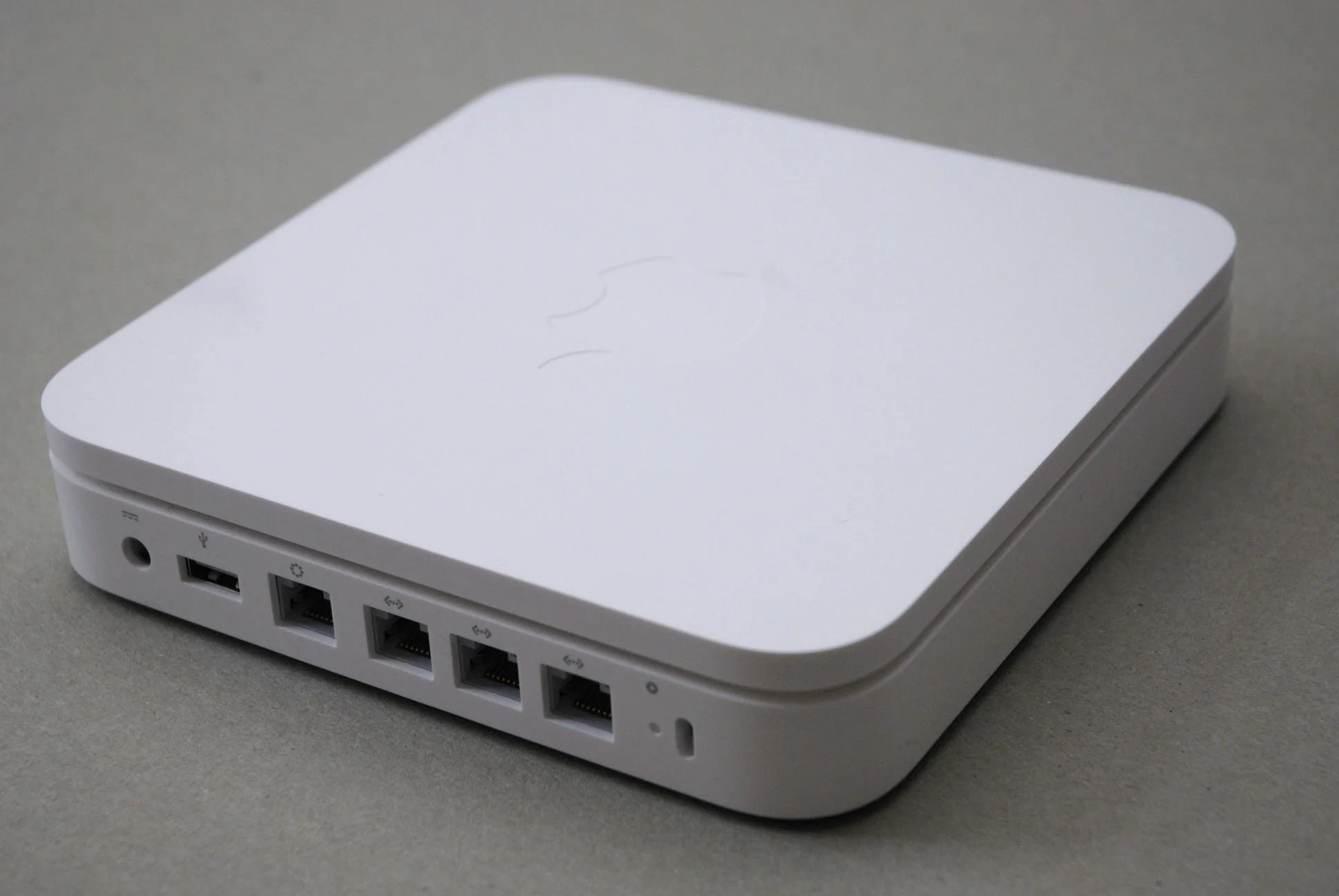
AirPort Extreme 80211.n (2nd Generation)

A1143 MB053LL/A

The AirPort Extreme Base Station features a simple, new design that is just 6.5 inches square and 1.3 inches tall, and a built-in USB port allows users to print wirelessly to a USB printer or turn any external USB hard drive into a shared drive so they can share files or backup valuable data from multiple computers on a network. New AirPort Utility software included with every AirPort Extreme makes it very easy to set up a secure, wireless network for up to 50 simultaneous users within minutes. Users can also set security restrictions, including Internet access limits on their childrens’ computers.

The AirPort Extreme Base Station also includes:

  • 802.11n Wi-Fi wireless networking;

  • MIMO (Multiple In Multiple Out) smart antennas;

  • dual-band antennas for 2.4 GHz and 5 GHz frequencies;

  • three 10/100 Ethernet LAN ports;

  • one 10/100 Ethernet WAN port;

  • one USB port;

  • Wi-Fi Protected Access (WPA/WPA-2), 128-bit WEP encryption; and

  • a built-in NAT firewall.

Mac OS X 10.5 Leopard

System requirements

Apple states the following basic Leopard system requirements, although, for some specific applications and features (such as iChat backdrops) an Intel processor is required:

Processor: any Intel processor, or PowerPC G5 or G4 (867 MHz and faster) processor

Optical drive: internal or external DVD drive (for installation of the operating system)

Memory: minimum 512 MB of RAM (additional RAM (1 GB) is recommended for development purposes)

Hard drive capacity: Minimum 9 GB of disk space available.

Leopard’s retail version was not released in separate versions for each type of processor, but instead consisted of one universal release that could run on both PowerPC and Intel processors. However, the install discs that ship with Intel-based Macs only contain Intel binaries.

Processor type and speed are checked during installation and installation halted if insufficient; however, Leopard will run on slower G4 processor machines (e.g., a 733 MHz Quicksilver) if the installation is performed on a supported Mac and its hard drive then moved to a slower/unsupported one (the drive may either be an internal mechanism or a Firewire external).

Mac OS X 10.4 Tiger

Mac OS X Tiger (version 10.4) is the fifth major release of Mac OS X (now named macOS), Apple's desktop and server operating system for Mac computers. Tiger was released to the public on April 29, 2005 for US $129.95 as the successor to Mac OS X 10.3 Panther. Some of the new features included a fast searching system called Spotlight, a new version of the Safari web browser, Dashboard, a new 'Unified' theme, and improved support for 64-bit addressing on Power Mac G5s. Mac OS X 10.4 Tiger shocked executives at Microsoft by offering a number of features, such as fast file searching and improved graphics processing, that Microsoft had spent several years struggling to add to Windows with acceptable performance.

Macintosh Plus

500px-Apple-Macintosh.jpg

The Macintosh Plus computer is the third model in the Macintosh line, introduced on January 16, 1986, two years after the original Macintosh and a little more than a year after the Macintosh 512K, with a price tag of US$2599. As an evolutionary improvement over the 512K, it shipped with 1 MB of RAM standard, expandable to 4 MB, and an external SCSI peripheral bus, among smaller improvements. Originally, the computer's case was the same beige color as the original Macintosh, Pantone 453,[2] however in 1987, the case color was changed to the long-lived, warm gray "Platinum" color. It is the earliest Macintosh model able to run System 7.